VAT Domestic Reverse Charge for Construction Services
Posted on 13th July 2026 by David Rudd
The VAT Domestic Reverse Charge (DRC) was introduced by HMRC on 1 March 2021 to help tackle VAT fraud in the construction industry. Exciting? Not exactly. Important? Absolutely.
If your business operates under the Construction Industry Scheme (CIS), it’s worth getting to grips with the reverse charge rules so you know when they apply and how your invoices should be prepared.
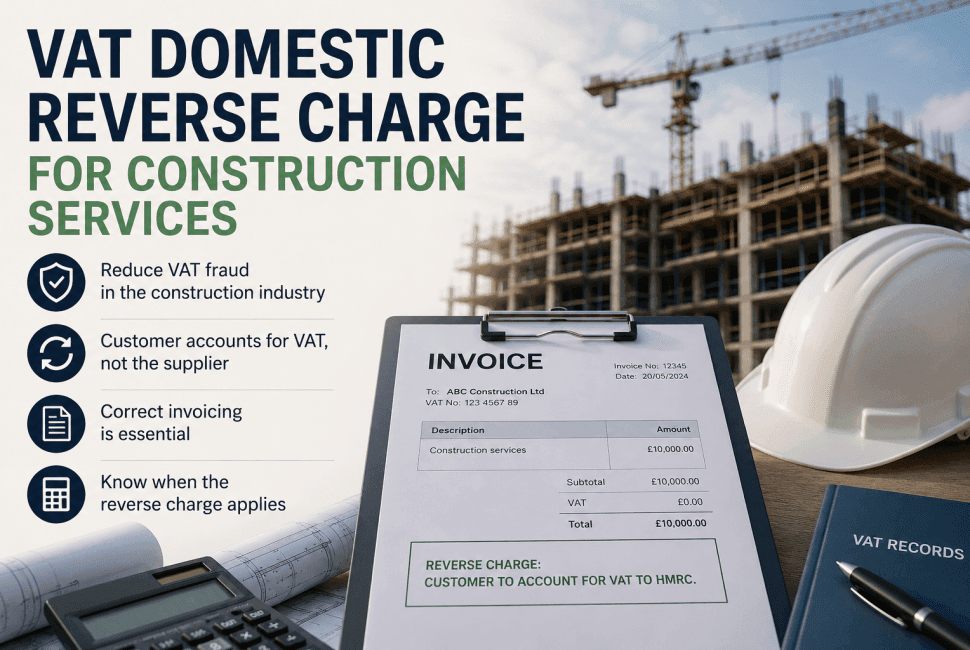
One of the biggest points of confusion is that, although the supplier doesn’t charge VAT in the usual way, the invoice should still show the VAT rate and the amount of VAT involved. Think of it as saying, “Here’s the VAT amount, but you’re dealing with it, not me.”
To see how it works in practice, imagine a subcontractor completes construction work worth £10,000 for a VAT-registered contractor. Under the old system, the subcontractor would add VAT to the invoice and collect the full amount from the contractor. Under the reverse charge rules, the subcontractor invoices only the £10,000 value of the work. The contractor then accounts for the VAT directly on its own VAT return. In other words, the VAT takes a different route to HMRC and skips the subcontractor’s bank account altogether.
For many subcontractors, this change has had a noticeable impact on cash flow. Previously, businesses would collect VAT from customers and hold onto those funds until it was time to pay HMRC. While that money was never really theirs to spend, having it in the bank certainly didn’t hurt. Under the reverse charge system, that VAT never arrives, meaning some businesses have had to keep a closer eye on cash flow forecasts and financial planning.
In practice, most reverse charge headaches come from applying the wrong VAT treatment or failing to confirm whether a customer is registered for both VAT and CIS. There can also be confusion around whether a customer qualifies as an end user, which changes how the rules apply. It’s the kind of detail that’s easy to overlook right up until HMRC starts asking questions.
As a result, many businesses have updated their invoicing procedures and accounting software to make sure transactions are handled correctly and consistently. A little extra effort upfront can save a lot of hassle later.
The VAT Domestic Reverse Charge is now a well-established part of the construction industry’s VAT system. While the rules can seem complicated at first glance, the basic principle is actually quite simple for certain construction services, the customer accounts for the VAT instead of the supplier. Understanding when the reverse charge applies, and when it doesn’t, can help you avoid costly mistakes, stay compliant, and keep your finances on solid foundations. And if you’re ever unsure, checking the latest HMRC guidance or speaking to a professional adviser is usually much cheaper than learning the hard way.
David is an Accountant with over 20 years’ experience in helping a large number of different business owners in numerous sectors from consulting agencies to every area of construction you can think of.
At home dealing with numerous different types of accounting software from Xero to QBO and everything in between. David is always on the lookout for new technology to help business owners to create more time for themselves and their teams.
With a healthy ambition of never resting on the results of yesterday, David is at his best when working with ambitious business owners who want to improve their businesses for eventual sale.
In his spare time, David is often found cheering on his boys at football, building Lego (which he pretends is for his boys) or watching the latest TV series on Netflix.
David RuddDavid is an Accountant with over 20 years’ experience in helping a large number of different business owners in numerous sectors from consulting agencies to every area of construction you can think of.
At home dealing with numerous different types of accounting software from Xero to QBO and everything in between. David is always on the lookout for new technology to help business owners to create more time for themselves and their teams.
With a healthy ambition of never resting on the results of yesterday, David is at his best when working with ambitious business owners who want to improve their businesses for eventual sale.
In his spare time, David is often found cheering on his boys at football, building Lego (which he pretends is for his boys) or watching the latest TV series on Netflix.
Learn More  01787 329 709
 info@stevenburtonandco.com