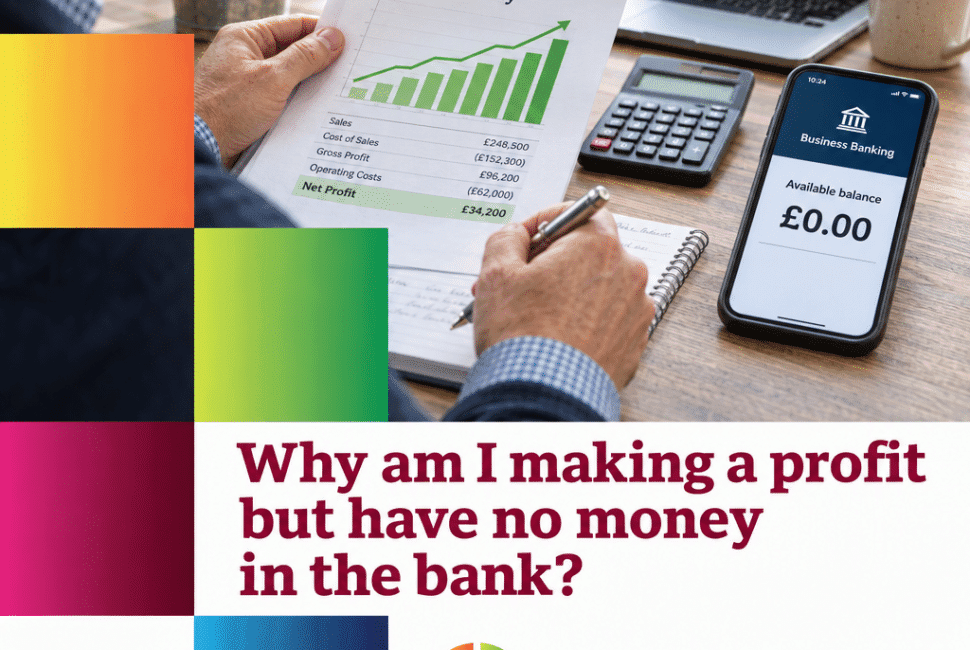
One of the most common questions we get from business owners is:
“My accounts say I’ve made a decent profit, so why isn’t there that much money in the bank?”
It’s a very good question.
And more importantly, it doesn’t necessarily mean anything has gone wrong.
Profit and cash are not the same thing.
A business can be profitable but constantly short of cash. Equally, a business can have plenty of cash sitting in the bank whilst not actually making much profit.
Understanding the difference can completely change how you look at your business.
What is profit?
In simple terms:
Profit = Sales – Expenses
If your business generates £500,000 of sales and has £400,000 of costs, you’ve broadly generated £100,000 of profit.
But that absolutely doesn’t mean you should expect another £100,000 to be sitting in your bank account.
Why?
Because your profit-and-loss account tells you how the business has performed.
Your bank balance tells you how much cash you have available right now.
Those are two very different things.
So where has my profit gone?
This is where it gets interesting.
There are plenty of perfectly normal reasons why a profitable business doesn’t have that profit sitting in its bank account.
1. Your customers haven’t paid you yet
You might raise an invoice for £20,000 today.
Depending on how your accounts are prepared, that sale may contribute towards your profit.
But if your customer doesn’t actually pay you for another 30, 60 or even 90 days, the £20,000 isn’t in your bank.
You’ve made the sale. You just haven’t received the cash.
As a business grows, this can become a serious issue.
You sell more.
You invoice more.
Your reported profit increases.
But you could actually become more cash hungry.
That’s why keeping an eye on how quickly customers pay is so important.
2. You’ve bought equipment or other assets
Let’s say your company spends £50,000 on a new piece of machinery.
The bank account falls by £50,000 immediately.
However, the whole £50,000 will not necessarily appear as an expense in your profit-and-loss account at the same time. Depending on the asset, accounting treatment and available tax reliefs, the accounting and tax effects can happen differently.
So you can have:
Good profit ✅
New machinery ✅
Much less cash in the bank 📉
Nothing has disappeared. The cash has effectively been converted into an asset that the business intends to use.
3. You’ve repaid loans
This is another common one.
Suppose the business repays £2,000 of a bank loan.
Cash has left your bank account, but repayment of the original amount borrowed isn’t normally a business expense in your profit calculation. Interest is treated separately.
So the business may be generating profit whilst using that cash to reduce debt.
Again, your bank balance goes down without an equivalent reduction in profit.
4. You’ve paid Corporation Tax
Successful businesses generally generate tax bills.
Corporation Tax is another cash payment that needs to be planned for rather than treated as money that is freely available to spend.
This is why we encourage businesses to look ahead at their likely tax liabilities rather than simply looking at today’s bank balance and assuming:
“We’ve got plenty of money.”
Some of that cash may effectively already have a future job.
5. Money has been taken out of the business
For limited company owners, money taken personally also needs to be considered carefully.
Salary, dividends, expenses and director’s loan transactions can all affect the amount of cash left in the company differently.
One particularly important area is the director’s loan account.
Taking money out of your company that isn’t salary, a properly declared dividend, repayment of expenses or another legitimate company payment can create an amount owed back to the company. Your company is a separate legal entity, so its money shouldn’t simply be treated as personal money. That’s something we’ve warned about in our previous director’s loan article –
[stevenburt…nandco.com].6. You’re holding more stock
Here’s another classic cash drain.
Imagine you normally hold £30,000 of stock but decide to increase that to £70,000 in preparation for growth.
That’s another £40,000 potentially tied up in the business.
That stock might eventually produce considerably more sales and profit.
But until it’s sold and the customer pays you, your cash is sitting on the shelf.
Let’s put it into numbers
Imagine your business has generated:
£100,000 profit
Sounds pretty healthy.
But during the year you’ve also:
- increased money owed by customers by £20,000
- bought £25,000 of new equipment
- repaid £10,000 of borrowing
- increased stock by £15,000
- paid £15,000 of tax
Suddenly it becomes much easier to understand why the increase in the bank account doesn’t resemble the £100,000 profit shown in the accounts.
The profit hasn’t necessarily disappeared.
The cash has simply gone somewhere else.
Why does this matter?
Because profit doesn’t pay the bills. Cash does.
You can have a profitable company but still struggle to pay wages, suppliers, VAT, Corporation Tax or other commitments when they fall due.
That’s why we don’t believe business owners should only look at sales and profit.
We want clients to understand the cash movement behind those numbers as well.
Knowing you’ve made £100,000 profit is useful.
Knowing where that £100,000 has actually gone is considerably more useful.
What numbers should I actually track?
You don’t need to disappear down a spreadsheet rabbit hole every Friday afternoon.
Start with a handful of numbers:
1. Sales
Are they rising, falling or standing still?
2. Gross and net profit
Are you actually making money from those sales?
3. Bank balance
How much cash is genuinely available?
4. Money owed to you
How much of your cash is sitting in customers’ bank accounts instead of yours?
5. Money you owe
What payments are coming up?
6. Tax liabilities
How much of the bank balance needs to be retained for VAT, PAYE, Corporation Tax and other liabilities?
Looking at these figures together gives you a much better view than simply logging into online banking every morning.
The key takeaway
Your bank balance is important.
Your profit is important.
But neither tells the whole story on its own.
A business can be profitable and run out of cash.
That’s why good financial management isn’t simply about knowing whether you’ve made a profit. It’s about understanding what happened to that profit and what is likely to happen to your cash next.
And that’s where regular, up-to-date accounts become genuinely useful.
Not just reports telling you what happened six or nine months ago.
Numbers that help you make better decisions today.
Need help understanding your numbers?
The Steven Burton & Co team are here to help you. If you need a sounding board, some advice or a steer in the right direction, then please don’t hesitate to get in touch.
This material has been prepared for informational guidance purposes only. Whilst every effort has been made to ensure the contents are accurate, information contained may not be comprehensive. Furthermore, it is not intended to provide, and should not be relied on for, tax or accounting advice. Steven Burton & Co Limited can not accept any liability for any errors or omission or for any person acting on or refraining from acting on the information provided. Steven Burton & Co Limited are not financial advisors.
 01787 329 709
 info@stevenburtonandco.com